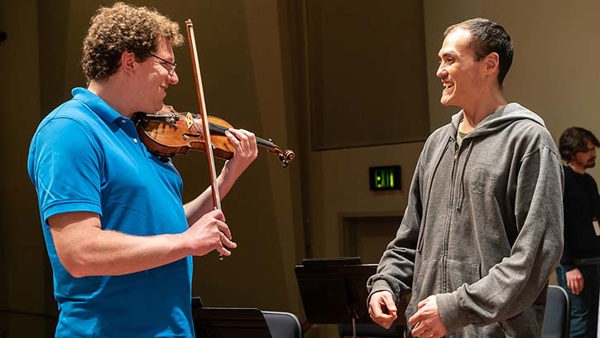
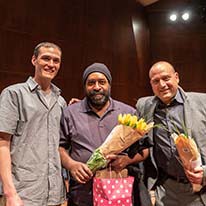
As part of our Community Connections program, we partner with local organizations to amplify the voices and stories of marginalized populations through music making project and performances. This includes song writing, chamber music works, to large scale compositions premiered by Seattle Symphony musicians.
2023-2024 Season
Returning to a landmark project from 2013, Potlatch Symphony 2020 unites the Seattle Symphony and Puget Sound's Indigenous artists together in an exchange that celebrates this region’s land and ancestral history. On April 19, 2024, the Seattle Symphony premiered this masterpiece at a free Community Concert at Benaroya Hall, showcasing the transformative power of healing through music and collaboration. As the Seattle Symphony's relationship with Indigenous artists and tribes continues to grow, we eagerly anticipate future projects to carry this work forward.
2022-2023 Season
Dear Humanity
Youth Art Festival & Concert
Dear Humanity for Youth Chorus and Orchestra, a student-led composition addressing climate change’s impact, premiered on April 21, 2023 as both the focal point and conclusion of the Seattle Symphony’s Dear Humanity Youth Art Festival.The multi-day event showcases projects by local youth artists that address emergent environmental issues.
“Combining musical craft and social commentary just makes sense,” says the Symphony’s 2022/2023 season Artist in Residence Angelique Poteat. The celebrated composer collaborated with 30 area teenagers to envision and orchestrate their melodic message. “Art is a reflection of our time, living and changing as our world changes,” she said. “Creating music inspired by [current] events … is a way to connect with people in a way that says that the music we share is intertwined with our lives and relevant to our human experiences.”
TeenTix builds a bright future for our region by empowering young people to take an active role in shaping their arts community as audience members, critics, influencers, advocates, patrons, and leaders. Through the TeenTix Pass Program, ANY teenager, 13–19 years old, can sign up for a FREE TeenTix Pass, which entitles them to purchase $5 day-of-show tickets at any of our 70+ partner organizations in the greater Seattle area. TeenTix also empowers young people through programming focused on learning and practicing arts criticism, podcasting, and leadership, as well as mentorship for BIPOC artists. For more info visit teentix.org.
Arts Corps is a nationally recognized youth arts education organization that works to address the race and income-based opportunity gap in access to arts education. Through participation in our arts integration, out-of-school arts and teen leadership programs, youth experience the transformative power of creativity and gain a deepened belief in their own capacity to learn, take risks, persist and achieve.
Speak With Purpose (SWP) is the only youth public speaking program incorporated into the public school day with the purpose of reaching every child that is silent in the back of the classroom and inspiring them to step forward to become the leaders in the front.
Coyote offers pay-what-works-for-you creative classes to youth ages 10-15! We believe in the power of youth voices and minds, and strive to spark creativity in young people by putting tools in their hands to build skills and forge their futures.
The Seattle Art Museum's Teen Programs invite young artists, thinkers, and innovators to make their mark on Art. Itching to make art, express yourself, take over the museum? Join our Teen Arts Group (TAG) and make new friends, create art, plan events, and ask questions about the world we live in.
Sponsors
Sunny Xia’s position is generously underwritten as the Douglas F. King Assistant Conductor.
Delta Air Lines proudly supports the Seattle Symphony’s Community Partnerships for Youth and Education.
The Dear Humanity Youth Art Festival is generously sponsored by Susan M. Coughlin and John K. Lauber.
Dear Humanity is presented as part of the Seattle Symphony’s New Music WORKS initiative, which is supported in part by a grant from the National Endowment for the Arts. New Music WORKS features commissions, concerts and educational activities that use composition as a catalyst for collaboration and engagement in music.
The Seattle Symphony’s Family, School & Community programs are supported by 4Culture, Marco Argenti, ArtsFund, D.A. Davidson, Delta Air Lines, J.P. Morgan Private Bank, The Klorfine Foundation, Merriman-Ross Family, the National Endowment for the Arts, the Seattle Office of Arts & Culture, the Paul G. Allen Family Foundation, and individual contributions to the Seattle Symphony Annual Fund.
2021-2022 Season
Executive Order 9066
80th Anniversary Commemoration
In this community composition project, composer Paul Kikuchi collaborated with Omoide (memories) Project team members of the Japanese Cultural & Community Center of Washington to reflect on the 80th anniversary of Executive Order 9066 — an order signed by Franklin D. Roosevelt in 1942 that stripped Japanese Americans of their civil rights and paved the way to the mass incarceration of over 110,000 people of Japanese descent, two thirds of them American citizens.
In Shadows, the culmination of a creative collaboration between composer Paul Kikuchi and the OmoideProject received its world premiere on October 16, 2022 in Octave 9: Raisbeck Music Center at Benaroya Hall
"The story of Together, This Journey is one of inclusivity.
"The musical material for this score was generated during a series of collaborative musical workshops I presented to a group comprised of clients from the Northwest Center — an organization dedicated to helping people of all abilities — and staff and musicians from the Seattle Symphony. Over several sessions, we developed compelling sounds, shared ideas about orchestration and built a formal structure. More importantly, over several sessions, we developed relationships, shared ideas through improvisation and built a community.
"While Together, This Journey uses every bit of material chosen by this group, it draws even more on the environment of these workshops, evoking the sense of building something together, of helping one another, of experiencing joy, and of anticipating the next gathering."
- Composer Charles Corey PREMIERE: February 9, 2023, with the Seattle Symphony, conducted by Lee Mills
Northwest Center client and Seattle Symphony Percussionist Matt Decker
2015 to 2019 Seasons
Simple Gifts
Seattle Symphony’s Commitment to Homelessness
The Seattle Symphony believes in the power of music to create positive impacts on people who are experiencing stress, isolation and challenges in their lives. In November 2015, the City of Seattle and King County declared a state of emergency over the homelessness crisis. According to All Home King County, homelessness impacts approximately 10,000 people on any given night in King County.
The Simple Gifts program aims to empower individuals experiencing homelessness or housing insecurity to connect with their creativity; develop deeper roots in the community through service, advocacy and collaboration; spark joy and inspire hope in individuals and communities that face disproportionate amounts of hardship; and raise awareness of the homelessness crisis that is occurring in King County.
The Shaker tune “Simple Gifts” was written in 1848 by Joseph Brackett and made famous by American composer Aaron Copland, who included it in his 1944 ballet, Appalachian Spring. In popular culture, this well-loved tune has come to symbolize simplicity, joy and freedom.
Explore our past Simple Gifts Project Below:
Resident of Mary's Place with Seattle Symphony percussionist Jonathan Wisner
Veterans at Compass Housing Alliance composed a new work for the Seattle Symphony. The music reflects their experiences in the service and their struggles returning to civilian life.
By Andrew Stiefel
It’s Saturday evening at Benaroya Hall. The windows glow in the fading light over the bustle of traffic on Third Avenue in downtown Seattle. Groups of people begin to gather for a concert, as they do almost every weekend, under the glistening glass chandeliers designed by Dale Chihuly.
But tonight they’re here for something different.
For the past three months, veterans from Compass Housing Alliance have collaborated with Derek Bermel, the Seattle Symphony’s 2018–2019 Composer in Residence, to write a new work for the orchestra. Tonight they’ll hear the world premiere during a free concert for the community.
Curated by the veterans themselves, the concert celebrates and honors service members, past and present, and reflects on their experiences returning to civilian life. For the veterans in the project, who are transitioning into stable housing after experiencing homelessness, it’s a moment to share their story with the rest of our community.
As the audience enters the hall, Chris and Steve, two veterans in the project, watch nervously in anticipation. The lights dim and the concert opens with the national anthem and a medley of anthems from each service branch. But then the orchestra turns to a new work — Bermel has set one of Steve’s poems to music.
“Three months ago if somebody had told me that somebody would be singing something I wrote on stage…I never would have believed them,” says Steve. “I was just thinking I was going to die in obscurity. Somebody would find my junk somewhere and throw it in the garbage. And that would be it.”
Guest vocalist Robin Henderson sings “My Continent, My County,” featuring poetry by Steve, a veteran from Compass Housing Alliance, and music by Composer in Residence Derek Bermel. (Photo: James Holt)
Guest vocalist Robin Henderson, a veteran of the United States Navy, sings Steve’s poetry for the gathered community. Her voice, richly expressive, soars as she sings his tribute to the nation he has served. For Steve, and everyone gathered, it’s an unforgettable moment. “I liked the young lady singing my song. That put a lump in my throat,” he says quietly afterwards.
The concert is a project of the Seattle Symphony’s Simple Gifts initiative. After consulting local nonprofit partners, the Symphony launched the initiative in 2016. In addition to creative projects, which bring the community voices and stories onto the stage, the program provides free tickets and encourages musicians, board, volunteers and staff to volunteer as part of regular service projects.
“The Seattle Symphony believes in the power of music to create positive impacts on people who are experiencing stress, isolation and challenges in their lives,” says Laura Reynolds, Vice President of Education & Community Engagement. “Through partnerships with organizations like Compass, we’ve learned that creative projects provide a safe, stable environment for participants and help connect people from different backgrounds through shared experiences.”
The project with Compass Housing Alliance is the orchestra’s fifth creative work created alongside community members through the Simple Gifts initiative.
The veterans in the project started preparing in February. Through a series of conversations about the music they loved, reactions to recordings of symphonic music, and discussions about their experiences in the service, Bermel and the veterans composed the piece together.
Chris, Steve and Derek Bermel take a bow together after the concert with the Seattle Symphony at Benaroya Hall. (Photo: James Holt)
Entitled Reflections on Service, the music incorporates the veteran’s voices over layered sounds in the orchestra. It moves from the intense emotions of joining the service and deploying to calmer, more optimistic sounds in the second movement.
“Every service member, everyone who goes in, your lifestyle changes. And you learn that aspect of it,” says Chris. It’s the returning home, and re-integrating into civilian life, that can be difficult, he explains. “This piece represents a movement out of a depressive state and forward in my life. To see the light and move forward.”
More than anything, the veterans involved with the project wanted the audience to see them as people like themselves — that their experiences alone don’t define them.
“We're your brothers, your uncles. We're your fathers, we're your sons,” Steve told everyone. “Our experiences have been a little bit different because our life path veered into a different direction, but we're just like anybody else.”
My Continent, My Country
By Steve Black
My continent, my country,
The land I’d like to see
My continent, my country,
The place I’d like to be
Shining in the sun
A land where I can run free
My continent, my country
Living hope stretched out before me,
Somewhere between the sea to shining sea
In between red, white, and blue
A space for me, a space for you
A place that means much more to me
Than what my eyes can see
Please always hold out the promise of freedom to me.
My continent, my country,
Living hope stretched out before me
Somewhere beyond the sea to shining sea
Please always hold out the promise of freedom to me.
Reprinted with permission from the author.
The Prism Project brought together youth in our community who are experiencing homelessness with Seattle Symphony musicians and 2017-2018 Season Composer in Residence Alexandra Gardner to create a new composition that was performed at the Seattle Art Museum.
Background
In the 2017–2018 season, the Seattle Symphony’s Simple Gifts initiative focused on youth homelessness, which impacted nearly 1,500 youth and young adults in King County. In 2017, The Pew Charitable Trust had reported that “After a concerted effort to count homeless young people, Seattle’s King County saw its numbers jump more than 700 percent between 2016 and 2017. And the number of homeless, unaccompanied public school students increased one-fifth between 2012 and 2015.” And according to the Raikes Foundation, “40% of homeless youth identify as LGBTQIA nationally and of these youth, 68% cite family rejection as a major factor contributing to their homelessness and 54% of LGBTQIA homeless young people indicate they were abused at home.”
The Project
Through a collaboration with community partners Accelerator YMCA, New Horizons and YouthCare, the Seattle Symphony co-created a residency and culminating concert with the following goals:
Creating a safe environment for young people to express themselves
Through composition, youth learn creative problem-solving, collaboration and communication skills
Create a community dialogue around continued steps to end youth homelessness
Composer in Residence Alexandra Gardner facilitated a 10-week residency of workshops for youth experiencing homelessness that culminates in a public community concert at the Seattle Art Museum with a performance by Seattle Symphony musicians of a composition developed during the residency.
Partners
YMCA, New Horizons, YouthCare, Seattle Art Museum
Sponsors
League of American Orchestras, Pride Foundation
Simple Gifts is supported by a generous grant from the American Orchestras' Futures Fund, a program of the League of American Orchestras made possible by funding from the Ann & Gordon Getty Foundation.
The Seattle Symphony’s Community programs are supported by the Ann and Gordon Getty Foundation, Citi Community Capital, KeyBank Foundation, the League of American Orchestras, the Puyallup Tribe of Indians, Tulalip Tribes Charitable Fund, the U.S. Bank Foundation, Wells Fargo Foundation, the Wilson Sonsini Goodrich & Rosati Foundation, Moe and Susan Krabbe and individual contributions to the Seattle Symphony Annual Fund.
We Are All Here
The Process
In March 2017 the Seattle Symphony and Path with Art presented the culminating concert of Path with Art’s community-based art project, We Are All Here.
The final composition draws inspiration from poetry and visual art created throughout the course of We Are All Here, which began in March 2016. Path with Art participants of the We Are All Here project worked with award-winning mural artist Kristen Ramirez and internationally acclaimed public artist Martha Rosler, in partnership with The New Foundation at the Seattle Art Museum, to write poems inspired by the students’ reactions to Seattle’s ever-changing social climate. The students then transformed the poems into visual art, creating banners that were displayed in Occidental Square in the summer of 2016.
Throughout the summer, the project challenged the broader Seattle community to submit poems to address “what it means to be community” through public poetry drop boxes. All of these poems were published on Path with Art’s website. From these, a jury of poets made a selection to inspire additional banners for the project.
In the fall of 2016, Path with Art students began a 16-week residency at the Seattle Symphony, drawing inspiration from the poetry created through the project. The students worked extensively with Symphony teaching artists Jessi Harvey and Lena Console to create the original community composition.
Seattle Symphony teaching artists guided Path with Art students to create an original musical score inspired by the We Are All Here banners. The 16-week residency explored how to compose a piece of music, inspired by art and poetry to promote social justice and change. The newly created score was premiered by Path with Art participants and a Seattle Symphony chamber ensemble on March 8, 2017, against the backdrop of the banners.
Path with Art Executive Director Holly Jacobson explains: “The We Are All Here banner project provided a venue for people from very disparate circumstances to have a voice, and to allow us to hear those many voices as one community. The process of creating a composition inspired by the poems and art from the project, and having it performed by our students — and Symphony musicians — is a perfect ‘crown jewel’ to finish this year-long, powerful collective work and exploration of the issues surrounding inclusion in a rapidly growing city.”
Program Notes
Written by Path with Art Composition Students
“We have saved you a seat.” This sentiment is a bit revolutionary or unexpected, because it gives the audience a chance to sit with us in loss, pain and trauma. Our culture has devalued people to the point that we now have “throwaway people”: the homeless, the disabled and seniors. But we have so much more to offer, gifts of perspective and strength. Adversity is a forge that creates unshakeable strength and depth of self-knowledge. All people have value, worth and uniqueness. We know who we are and we know we are here. We wish for the world to see everyone, despite housing and employment, as unique, talented and valued individuals. This composition shows the discordant crisis, challenges and strength of people to persevere, so that EVERY person can find a place in the fabric of life.
This piece shows the arc of the reality of homelessness to the dream of the ideal world back to the reality we are in, but still full of hope and questions for the future. Unending exposure to the weather is a recurring theme throughout the piece. The opening storm parallels the storm of people experiencing homelessness with its extreme uncertainty and chaos. Cello runs accented by dissonant chords mark the anxiety and franticness of the unknown. Sirens in the flute and violin throughout the first section represent the constant threat of being criminalized for existing in the margins as well as the danger of the streets. Some people find shelter within a tent city. Various instrumental motives represent the people and their different conversations: positive, negative, internal and external. We move to a cry by the clarinet of, “See me, I am here,” to declare people’s right for existence. The anxiety and storm return with the entire group playing, working together for survival.
The middle section, with the chorus of “We paint the world beautiful,” shows the picture of the ideal world as it should be and the hope that society see everyone’s worth and value. Melodic lines from different cultures — klezmer, folk, samba, African, jazz — show the multi-colored threads weaving the fabric of society. We paint the rainbow with the color wheel of life, dipping our brush, showing the power art has to express our diverse experience, welcoming people to join us.
The final section returns with the storm but punctuated by “sunshine” chords, slowly abating away to additional conversations, among the various cultures. Yet the internal cry to be seen remains. The piece ends with the layering of several motives showing that social justice and change is possible through everyone working together. The final siren keeps us grounded in the reality we are in, but transforms to give the final message of not knowing the future, still hoping for change.
Artist Statements
B.
With Martha Rosler’s visit to our banner class last summer, I realized that humans have rights. This composition is my journey from trauma & homelessness to my brain healing so that I began to function better to living in a society where human rights are not respected, challenged & even dismissed. Despite homelessness and a mental health diagnosis, we all have the right to be respected, we all have a place in society…we are all here. I’m thrilled to be performing my saw blade instrument that was originally created & performed at the Trimpin performance.
Lynn A. DeBeal
I stopped making music 10 years ago when pulmonary fibrosis put an end to 30 years of making music. This project has helped me find my love of music again. I am back to playing my violin for the first time in 10 years. I bought a guitar, have a new attitude about my damaged lungs. Thank you.
Jennifer Lee Hamilton
This piece means to me: I have found no way to express the experience in my spirit of the street life. It was as if it had its own unknown language. This piece expresses the experience clearly & honestly. I am regenerated through this class.
Marian Hayes, seattlesmog
God created the Heavens and made such MARVELOUS music that I’ve been listening most of my life!! So now I play clarinet, violin, and recorder. This class and concert means so much to me because it’s a way to tell God THANK YOU!! for creating me and letting me know that I DO BELONG with everyone else!
Aaron J. Hill, A Homeless Man
Despite being a film score aficionado since I was a teenager, for some reason I never went beyond listening, until this class with Jessi and Lena, where I've learned about a great many aspects of composition — “crunchy chords” and tempo and articulation, etc. I had grand plans for this composition. Some came to fruition and others did not, but collaborating with others was fun. Realizing that I had similar ideas to so many others, it became a synergistic effort. Often we supplemented one another. Please note that this is a greatly abridged version of my thoughts and experiences. For a more lengthy and detailed artist's statement, please visit a special section dedicated to the subject on my blog: aaronjhill.wordpress.com/music.
Jennifer Love
This piece was lovely to work on and instigated many honest and empowering revelations about surviving and even thriving against the sheer rock face of growing income divides. Working on this piece with Path with Art I learned the dance of collaboration, stepping back to admire the genius and shine of my fellow composers, and stepping forward when my own ideas were ready to shine.
Paul H. Otis
I like this piece that is mellow because it is kind of swing, and I can add guitar notes where they belong. And it will be a fun evening. My experience writing this music was a challenge for me but I’m getting there. I have some ideas about the piece since I am a good musician.
Amy Pau
I am not consider myself as an artist. I am a lifelong learner. I love to learn, especially with Path with Art. I joined Path with Art for ten months, but I joined some of their classes. I joined dancing class, drumming class, hats class. All of the instructors are excellent. Now I am joining the “Create a Score” class. I learned a lot about music from the instructors.
About Path with Art
Path with Art is a nonprofit arts organization that exists to provide access to the arts to no-to-low income adults recovering from homelessness, addiction, domestic abuse, physical and mental illness, and other trauma. In partnership with over 30 social service agencies, 25 arts organizations and 30 renowned teaching artists, Path with Art’s multi-pronged programming harnesses the power of creative engagement as a bridge to community and a path to stability.
Formed in Seattle in 2008, the Path with Art model is being sought after by communities nationwide. Recently, Path with Art served over 600 participants in Seattle at no cost to them or their partner organizations through:
Arts education
Public exhibitions and performances
Access Art: guided trips and tickets to museums and civic arts institutions
Community Connections: art-making opportunities that bring our participants in collaboration with the broader public
The work is driven by a vision: A world where arts engagement is recognized as transformative — connecting the individual with the self, the self with community, and communities with society. In this world, the power of arts engagement is available for all.
This is the second public performance collaboration between Path with Art and the Symphony; in 2015 Seattle Symphony artist in residence, Trimpin, taught a class which resulted in a standing room only performance in Benaroya Hall. Additionally, Path with Art’s choir, The Path with Art Singers, rehearses weekly in Octave 9: Raisbeck Music Center at Benaroya Hall.
In the 2016–2017 season, the Seattle Symphony partnered with local organizations to present an innovative performance of Charles Ives’ New England Holidays in February 2017. In a series of workshops leading up to the concert, members of the community worked with visual artist Becky Aitken to reflect on the holidays represented in Ives’ composition through the lens of their own experiences. Seattle’s Civic Poet Claudia Castro Luna created new poems to bring together Ives’ story with the stories of our local community. Ives’ New England Holidays is a work of art that sparked conversations, inspired reflection, and amplified the voice of participants to build deeper connections to our community partners and for audiences experiencing this music in the concert hall.
About Claudia Castro Luna
Claudia Castro Luna is Seattle’s Civic Poet, the recipient of a King County 4Culture grant and a Jack Straw Fellow. Born in El Salvador she came to the United States in 1981. She has an MA in Urban Planning, a teaching certificate and an MFA in poetry from Mills College. She is the author of the chapbook This City, published by Floating Bridge Press. Her poems have appeared in Poetry Northwest, La Bloga, City Arts, Taos Journal of International Poetry and Art, among others. Living in English and Spanish, Claudia writes and teaches in Seattle where she gardens and keeps chickens with her husband and their three children.
Becky Joy Aitken is a Seattle-based artist, illustrator and educator. In her own art, she enjoys transforming found objects into quirky illustrations. As an art educator, she loves walking with her students through the creative process in hopes of helping them discover their own creative joy. In her work as a teaching artist for the Seattle Symphony, she has the privilege to combine the joys of music and visual art as a means of inviting a diverse community to participate with the Symphony in experiencing the power of music. Becky holds a Masters of Fine Art in Illustration from Savannah College of Art and Design. Her illustration and animation work has won awards from American Illustration, Applied Arts Annual and International Motion Art Awards.
In the Lutheran tradition of caring through service, Compass Housing Alliance develops and provides essential services and affordable housing for homeless and low-income people in the greater Puget Sound region.
Veteran Programs: Military veterans experience post-traumatic stress, injury and other unique challenges as they return from duty and re-integrate into society. Compass Housing Alliance offers a variety of programs and housing that meet the specific needs of military veterans and their families, so that the men and women who served our country are not forgotten.
Cascade Women’s Program: Since 1999 Cascade Women’s Program has provided a safe place to live and access to vital resources for homeless women in Seattle. The sobriety-intended program provides 32 units of transitional housing for women, along with case management and support from a skilled, compassionate staff. Residents may stay in the program for up to one year while working to overcome barriers to housing.
Mary’s Place is a nonprofit organization that empowers homeless women, children and families to reclaim their lives. Mary’s Place provides respite, nutrition, safety and shelter in a setting where self-confidence is restored, hope is discovered and a new future begins. Mary’s Place opened in 1999 as a drop-in day center for single women. In response to the increasing numbers of families experiencing homelessness, Mary’s Place currently operates six emergency night shelters for families and two day centers.
Rooted in Catholic Social Teaching and the Gospel imperative, Catholic Community Services and Catholic Housing Services are outreaches of the Catholic Church in Western Washington, under the leadership of the Archbishop of Seattle and the Boards of Trustees. Their employees and volunteers come from many faith traditions to serve and support poor and vulnerable people through the provision of quality, integrated services and housing. Their focus is on those individuals, children, families and communities struggling with poverty and the effects of intolerance and racism.
Learn more about Dorothy Day House at www.ccsww.org.
We Are the Art
The Process
The goal of We Are The Art was to provide formerly homeless participants with an opportunity to discover their voices and share their stories through music. In this 6-week course, participants worked together to create a group composition. Along the way, they became part of a community – both with one another and with the Seattle Symphony. Teaching Artist, Lena Console, facilitated conversations to generate community agreements, deepen individual person reflection and make artistic choices together as a group.
Art
We are the art
the earth composes
so let us
appreciate beauty
in each other.
- Poem by Hannah Scarlet
We Are the Art
I. Moonless Night
Dark, black night. Bright stars out of reach. Seeking and not obtaining.
Unknown paths. We wander through our lives, unable to…
II. Forest of Desire
Living in darkness, we come to know the unseen rule of life: struggling from
desires. We dance toward a light that is not there and don’t know where to go.
There is no music in our souls.
III. Finding the Fire
After wandering endlessly, seeking from the outside, we come upon ourselves.
Inside, we see a small spark, a glimmer of music.
IV. Radiance
We have a star inside our souls. A light that blinds yet makes the unseen seen.
We have music inside our souls. We sing our song.
About Plymouth Housing Group
Plymouth Housing Group’s mission is to eliminate homelessness and address its causes by preserving, developing and operating safe, quality, supportive housing and by providing homeless adults with opportunities to stabilize and improve their lives.
Visit plymouthhousing.org to learn more about Plymouth Housing Group’s work.
Lost & Found with Trimpin
Participants from Path with Art attended an 8-week workshop with inventor-artist Trimpin to design and build an instrument made out of found, broken and retired objects that resonate to make sound. The workshop covered the basic mechanics of robotics in the process of constructing a unique instrument. This event is the culmination of a 3-year Seattle Symphony residency with the world-renowned Trimpin.
Welcome to our labyrinth A chaos of notes Our science of sound Let us amplify the frequency Within your hearts What might this be you ask? It’s not a simple answer As you can plainly see. You might want to call it Trippin out With Trimpin A dynamic energy A melody Of good vibrations Sssh…can you hear that? This is the instruments voice Uniquely orchestrated An innovation Of dancing spirits The community making magic Bridging the sounds from us To you The art of music can come in many forms We hope you enjoy our collaboration Of our version of the psychology of sound The instrument’s voice. – By Angel
Artist Statements
CJ ChambersI am not sure that I would consider myself as an artist yet. Just started at Path w/Art a few months ago. I am more of a craft person. I like helping make things, solving problems, sharing ideas. Leaving the musical elements to people who know how play instruments, I have enjoyed making contraptions that can be used to make sounds. Glad to help in ways I can. Thank you.
The TricksterFor me the howl is a mystery and symbolizes a lone yet social empathy of healing. My medium is wire which represents openness and was best suited for my skill set.
Michael DareViolins are too hard to play. Wouldn't it be nice if they could play themselves?Take one: The Violin Family, clearly the bass has given birth to several mutant children who will grow up to be the world's first self-playing string quartet. Due to postpartum depression, mom has been atonal since the birth while dad, the electric guitar, is off who-knows-where practicing a solo.
Martha FurlongI took a Path with Art drumming class a little while ago and Eduardo, the teacher, taught us how to make sticks to beat the drums with. That gave me the idea to make my own maracas. My maracas are made out of coconut water cans, dried beans, and duct tape. They are rhythmic instruments.
BThe class opened my mind that everything created a sound, but having that sound be initiated in a performance setting was the real challenge. Using what I could find through recycled plastic and glass bottles, my castoff ceramic pieces and metal saw blades, I found tones through vibration; unseen waves filling the space with sound. By achieving this I find my door into the world of Trimpin.
Aaron HillWhile looking at a plastic cup from Starbucks one day, I thought, “How could I make these into something musical?” So Trimpin and I began experimenting. We’ve inserted duck calls and recorders inside the cups that play when air from balloons is released.
AnonymousI call my contribution Falling. It is inspired by gentle winter rain. I was interested in weaving together gravity and atmospheric responses — in exploring time through natural elements. My hope is that the result of my work is peaceful and pleasant music that inspires serenity in the observer.
Mary MoodyInspiration, creative free will… I hope my work conveys the power of collective creative, genius minds.
Ruanda MorrisonInfinityIn the beginning when God created heaven and earth the BIBLE (Book of Instruction Before Leaving Earth) says he saw which is visual. The BIBLE does not say when sound began. I imagine that sound began as rainsticks. Sound is like the wind; no one knows where it came from nor where it goes to. Sound is like the wind — a continuous loop that has no beginning or end. This is the reason I call this piece Infinity.
Jessie PedroBlend Through WindMy experience has passed as I built and designed my mechanical piece. Your turn to experience my piece. Remember, your experience is your story of my mechanical music instrument. Give it a whirl, you may never know where your story will take you.
AnonymousCreative cacophony stretching the brain Right angle relationships from Pythagoras Scores of sounds in colored movements Twas…phantasmagoric…trippin' with Trimpin at Benaroya Hall!
MazzynobleWhen I took this class I had no idea what to expect. Working collectively as a group, I was unsure what I had to offer. After a few classes it dawned on me that this is the definition of Community. The beauty of Art is that it can be molded into many forms. To be able to add something of my own freedom of self-expression and put it together with other artful minds-alike, demonstrates the beauty of a Community in its artful form.
Daniel de la CruzWell, I knew what Trimpin’s work was, and that’s what made me take the class. I saw his work at the EMP — the guitar. Everyone’s work was hard, so I picked something simple: a robot called BOBO. She makes me feel alive because I built her from my heart. We all needed a visual piece to go with the music.
Trimpin
Born in Germany in 1951, Trimpin moved to Seattle, Washington in 1980 in search of found objects from the aviation and technology sectors that he could repurpose for art installations. Since then, Trimpin has become widely recognized as a kinetic sculptor, sound artist and musician, and his work can be seen through many commissions and public art projects in the Puget Sound region, across the country and around the world. Recipient of numerous awards and grants, Trimpin was awarded a MacArthur “Genius” Award in 1997.
About Path With Art
Path with Art transforms the lives of people recovering from homelessness, addiction and other trauma by harnessing the power of art as a bridge to community and path to stability. They believe that all people deserve the chance to create and access art, regardless of their background or current circumstance. They are also driven by the vision: A world where arts engagement is recognized as transformative — connecting the individual with self, the self with community and communities with society. Every day they see the students in their award-winning arts education and access programs become more confident, stable and deeply connected in the world.
Thank you to the following organizations and individuals who donated instruments to this project:
Bill Anschell, Bischofberger Violins, Rebecca Cowan Hernandez, Guitar Center, Barry Lalonde, Ellen Morley, Radio, Roosevelt High School, Janene Sohng, Lorna Soules and Hanna Tyo
Trimpin with the Seattle Symphony is made possible through Music Alive, a residency program of the League of American Orchestras and New Music USA. This national program is designed to provide orchestras with resources and tools to support their presentation of new music to the public and build support for new music within their institutions. Funding for Music Alive is provided by The Andrew W. Mellon Foundation, The Aaron Copland Fund for Music, and The ASCAP Foundation Bart Howard Fund. Additional support for Trimpin is provided by Moe and Susan Krabbe.
2013 to 2015 Seasons
Native Lands
A Community Composition Project
The Native Lands Project started with the desire to build cultural understanding and respect through music between the Seattle Symphony and tribal nations in the Puget Sound region through creating new art together. This joint composition between the Seattle Symphony and Native artists was curated by local composer Janice Giteck and premiered in September 2013 and was performed again on March 14, 2015, at the East Shore Unitarian Church in Bellevue.
Special thanks to the kwax-wad-ad-achi Cultural Family, the Puyallup Tribe, the Shooting Stars Performance Ensemble and the East Shore Unitarian Church.
The Process
The Potlatch Symphony composition was the result of three years of partnership and collaboration, including:
Cultural exchanges: facilitated sharing of traditions and ideas between six Pacific Northwest tribal groups and Symphony musicians and educators.
Composition: Janice Gitek incorporated the sounds and ideas from the culture into the final composition.
The world premiere performance: the Potlatch Symphony was presented as part of Seattle Symphony’s free Day of Music celebration at Benaroya Hall in Seattle in September 2013. Participants included Native violinist Swil Kanim and Native flutist Paul “Che oke ten” Wagner, Native youth, students from Cornish College of the Arts and musicians of the Seattle Symphony.
Second performance: an encore performance of the Potlatch Symphony took place at the East Shore Unitarian Church on March 14, 2015. Audience members were encouraged to bring their own drums to the performance for a group jam session.
The Seattle Symphony gratefully acknowledges the Burlington Northern Santa Fe Foundation, the Ann and Gordon Getty Foundation and the League of American Orchestras for their generous support of the Native Lands Community Composition Project.
Sponsors
The Arakawa Foundation proudly supports the Seattle Symphony’s Youth Education Partnerships. Additional support is provided by Delta Air Lines.
The Seattle Symphony’s Family, School & Community programs are supported by 4Culture, ArtsFund, the Merriman-Ross Family, and individual contributions to the Seattle Symphony Annual Fund.